

The Essence of Practice: Spring Retreat with Matthew Lowes
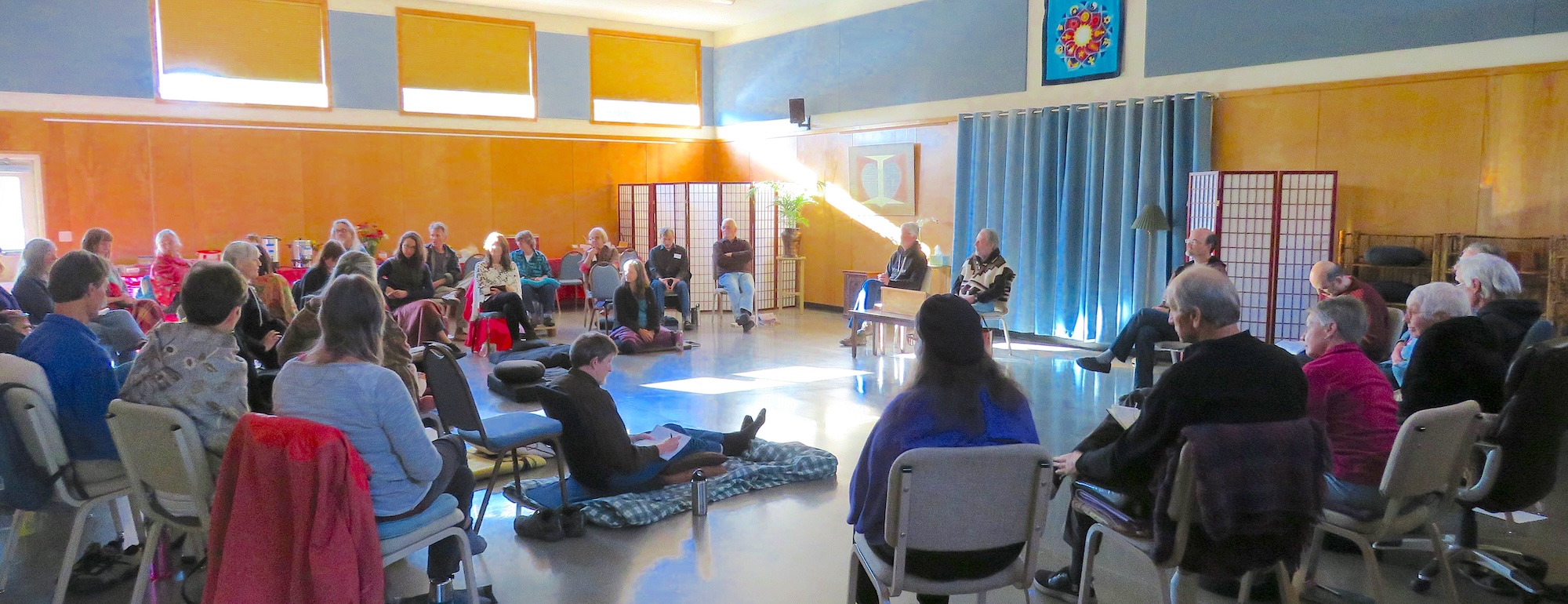
Matthew Lowes led the 2026 Spring retreat from May 11-16 at the Center Meeting Hall. In this five day non-residential retreat titled "The Essence of Practice" practitioners explored the essence of the perennial practice of the spiritual path.
 "Knock, and the door shall be opened to you." |
Retreat Participants: Matthew Lowes, Rick Ahrens, Genie Harden, Liba Stafl, Sophia Malkasian, Barbara Goldberg, Jack Yousey, Rich Holloway, Shirley Chase, Elvira Dizon, Joel DeVore, Sally Snyder, Mark Hurwit, Melissa Kaspar, Jude Kieda, Donald Burton, John Rogers, Douglas Turvey, Sylvia Litchfield |
The Essence of the Spring Retreat by Matthew Lowes
For a while, I have been thinking about the phrase “Perennial Wisdom,” as that wisdom which appears again and again, across traditions, cultures, and time. I thought there should be a corresponding “Perennial Practice.” If the perennial wisdom is that Gnosis is possible, the perennial practice would answer the question “How?” I was interested in sharing with people what I thought was the Essence of Practice. That’s how I arrived at the theme for the spring retreat. That essence is comprised of quieting the mind and inquiring into the nature of reality through direct experience. In short, the perennial practice is meditation, in all its various forms, especially if we take meditation to be the heart of a progression that begins with morality and leads to insight.

Universal Methods of Meditation. Diagram by Matthew Lowes
There are, of course, many differing meditation techniques and instructions, but there are also what I consider to be core practices. There is essentially a throughline that passes through some universal methods: Concentration, Selective Awareness, Choiceless Awareness, and Turning Inward (Self Inquiry). The spring retreat teaching illuminated the universality of these methods and our practice focused on diving into them. These core practices correspond to the Center’s principles of Attention, Commitment, Detachment, and Surrender. They also correspond to what I have previously written about as the primary modes of practice, which are Focusing, Observing, Manipulating, and Emptying.
When you see all this line up, it’s tempting to think they are direct correspondences and the path is a kind of strict linear progression. While there is a progression here, in the sense that each practice, principle, and mode leads naturally into the next one, the actual path is not strictly linear. As we return again and again to a practice, more is revealed to us, and each practice contains within it all the principles and all the modes. Imagine the practices, principles, and modes in three concentric rings. Imagine each ring turns independently at different speeds. At any moment, your practice could fall anywhere on this map, like a kind of cosmic slot machine, but as long as the wheels keep turning, you cannot win or lose.
If you’re interested in more depth on all this, listen to the Sunday talk I did just after the retreat. It’s a kind of summary of these teachings. Then dive into the practices and discover for yourself where they lead. Watch the recording.
Guest Speakers: Kimberly and Jim Carson

Jim and Kimberly
Guest speakers Kimberly and Jim Carson gave a talk at CSS on Sunday May 3 titled "Tantric Layers of the Supreme Voice of Silence." In this talk, Kimberly and Jim guided us in an exploration of an ancient map of the four layers of sound, all arising out of and dissolving back into Silence.
Kimberly Carson, MPH, C-IAYT, and Jim Carson, PhD, have studied, practiced and taught the wisdom of Kashmir Shaivism for a combined 80 years. As spiritual directors of the Circle of One meditation community, their offerings center on translating mystical insights and teachings for the western mind. The Carson's Know Thyself Meditation approach systematically explores the discovery, practice, and sharing of nondual devotional recognition. They have published two books, dozens of scientific studies of the clinical application of Eastern wisdom, and lead professional trainings for yogis and healthcare providers. Learn more at MindfulYogaworks.com.
Guest speaker Eli Recht

Eli Recht
Guest speaker Eli Recht gave a talk at CSS on Sunday June 7 titled "Making Friends with All of Life." In this talk, Eli invited us to imagine experiencing every moment as a welcome opportunity for spiritual awakening, and a portal to our essential peaceful and joyful nature. Drawing on multi-faith sources, Eli explored how this is not only possible, but also practical, loving, wise, and ultimately inevitable. We learned how to befriend our lives and realize our Oneness with Life Itself. Watch the recording.
Eli Recht is a licensed psychotherapist, clinical supervisor, spiritual counselor, editor, and teacher of Self-Realization in Encinitas, CA. His specialty is blending modern psychological knowledge with timeless spiritual wisdom. For more information, visit elirecht.com.
Illuminating Moments

Moon Light — An Illuminating Moment by Merry Song

Merry Song
I wish I could remember more clearly the moment I became aware of the moon. I was 16, living in the apartment above my parents’ house. Every night I would stay up late—sometimes all night. I wrote, read books, played guitar, sang, and listened to music on the radio. Mostly I remember the mood of it all: melancholy. I was alone every night with hours to myself. No TV. No phone upstairs. Only one phone in the kitchen downstairs on a short cord. So, at night in my three-room apartment, it was just me and my longing to express myself and communicate my lonely creativity.
I remember crying. I remember fantasizing lovers. I worried about everything I wrote—I felt I needed it to hide it out of fear of being exposed to criticism. I wanted the freedom to really write. I wanted to communicate intimately with someone. I wanted response.
One night I stared out my bedroom window into a darkness that seemed to weigh me down with this question: Would I ever find what I was looking for?
Then I saw it: the leading curve of a giant full moon. Of course I had glanced at the moon before, but I hadn’t actually “seen” it. This time, in a silent moment, I saw myself seeing it. I felt anticipation as it rose and illuminated the darkness—my inner darkness, too.
I wrote this line: Milky moon steals my logic. I think back, lifting time above all reason.
I say I want to remember it more clearly, but I realize now that the brilliant clarity never dissipated. I was there. I wrote the poem. Now as I reflect on that illuminating moment, I realize that the moon and I connected that night in a communication I longed for. A communion. And I still commune with the moon. She calls to me to look upon her each month with an amazing camera lens that pulls her right into my eyes. My heart. She connects with my inner moon, reminding me to also rise up and illuminate the darkness.
A Sudden Understanding of the Nature of Opinions — An Illuminating Moment by Niraja Lorenz

Niraja Lorenz
Merry Song and I are driving south on I-5 heading to the Mount Madona Center in the Santa Cruz hills where we will attend a five-day retreat with Adyashanti. As we drive, we are listening to tapes of Adyashanti. It is part of a long retreat, and listening helps us pass the time and also results in interesting discussions. After Adya’s talk, he asks for questions. A woman begins talking. She has a very strong view about abortion and can’t understand how others could feel differently. I can relate to all she is saying. I too, like the questioner, have a strong opinion and believe that my view is correct. Adya engages in a dialogue with her on the nature of opinions.
Then, she reveals that her opinion is not the same as mine; in fact, it’s the opposite of mine! In that moment I deeply understand that no opinion is true, that beliefs are neither true nor false. Beliefs and opinions are simply constructs that our minds have created based on our conditioning. I am astonished by the clarity of this realization.
My understanding has remained with me over the intervening 15 years. That is not to say that I no longer have opinions. I have many. But rather, I quickly recognize them for what they are: conditioned beliefs. My perspective is a result of the life I have lived, the conditioning I have experienced. This realization is valuable to me now as I attempt to understand and communicate with those who hold beliefs that I see as wrong or harmful. In this way I am more present to how people cling to opinions and try to prove that they are right. When we see the true nature of our beliefs, they are then free to self-liberate.
In The Reality Garden — A mystical parable by Joel Morwood

Joel, circa 1993. Photo by Merry Song
Once there was a young artist named Every Wo-man who had grown bored with her painting. Although her unusual abstracts were highly acclaimed by the critics, she herself had come to view them as fatuous and self-indulgent. She longed to do something substantial with her life but didn't know what that could be. One day, passing a house for sale with a large yard, she got an inspiration. She would buy the house and turn the yard into the world's most perfect garden.
What, after all, could be more substantial than dipping one's hands into the rich earth, digging out solid rocks, and planting living seeds! Here was a project worthy of her energies. In fact, so engrossed did she become in creating her perfect garden that for several years she neglected her painting altogether. During this period Every Wo-man wrote a number of letters bragging about her garden to a philosopher friend who also happened to love gardens but lived too far away to visit hers in person. After a while she received a letter back, complaining that her descriptions of the garden were so subjective it was impossible for him to make an independent evaluation of it. Instead of portraying her garden in words, he suggested she paint a picture of it, depicting everything as "objectively and realistically as possible." That way he could judge for himself whether it was as "perfect" as she claimed.

"Abundance" fiber art by Niraja Lorenz
This proposal delighted Every Wo-man. She hadn't painted anything realistic since art school. To do an old-fashioned landscape would be an exhilarating challenge. Happily, she prepared her canvas and paints. But walking around in search of a spot to set up her easel, Every Wo-man started to realize that complying with her friend's request was going to be more difficult than she had first supposed.
To begin with there was this problem of choosing an angle. Each angle presented her with a different view, but which view would represent the garden as it really was? Obviously no single angle could. To represent the garden as it really was would require painting it from many different angles. But even if she decided to do this she realized that the number of possible angles was infinite. Moreover, having studied a bit of math, she also realized that any finite number subtracted from an infinite number still leaves an infinite number. This meant that no matter how many perspectives she painted of her garden, an infinite number of equally real perspectives would necessarily be left out.
She decided the most rational thing to do would be to adopt a cubist style that could suggest several perspectives at once and, thus, (by implication) the infinite possibilities which lay in between. Moving from one location to another she began to paint her picture, weaving the various angles together as smoothly as she knew how. But after working in this manner for several hours, she noticed another problem just as troublesome as the one of perspective.
She had started her painting in the morning when the garden's colors all had a crisp blue tinge. Now it was noon. The light had changed and everything sparkled with an almost unbearable brilliance. Consequently, what she had painted earlier in the day no longer matched what she was working on at the moment. What's more, the colors would continue to change, so that by evening the garden would again be transformed-this time from its present brilliance into a muted scene suffused with orange hues.
But that wasn't all. Currently it was spring and the tulips were in bloom. By summer, however, the tulips would be gone and the garden would be dominated by roses. And in the fall the roses would die and the chrysanthemums arrive. In other words, not only were the garden's colors constantly changing, but the actual plants themselves would all be transformed with the seasons.

Photo by Merry Song
Thus, just as choosing a particular angle falsified the garden's actual or total reality (by excluding an infinite number of possible alternate angles), so choosing to paint it at any particular moment would also leave unrepresented all those other infinite moments which were no less real.
Again, the only way she could see out of this dilemma was to paint the different seasons and times of day simultaneously, even if this meant juxtaposing evening hues with morning ones, and superimposing chrysanthemums upon tulips.
By late afternoon the painting was almost finished and Every Wo-man stepped back to survey her work. Although the picture was somewhat disorientating, with its bizarre mixture of angles and hours, still she had promised to depict "everything" and everything seemed to be there-flowers, bushes, gnarled trees, moss-covered rocks, pebbly paths, clumps of ferns, etc. Upon reflection, however, she realized that there was still one thing missing—herself. Was she not in her garden? Obviously, she was. Why, then, was she not in the painting? Obviously, she should be.
The problem was that, although Every Wo-man was quite certain her whole body was in the garden, all she could see of it was her hand holding her brush in front of the canvas. If she were to paint her whole body, she would have to use her imagination and that would be a violation of 'objectivity'. In the end, she settled on depicting only what she could see—her hand and brush.
This accomplished, all that remained to be painted was a single blank space, about the size of a postage stamp, right in the middle of the canvas. What this space represented was that portion of the garden which was blocked from view by the painting itself. But as Every Wo-man started to peer over her easel, it suddenly occurred to her that her painting was also an object in the garden. If she was going to paint the garden as it actually was, with everything in it, then she would certainly have to include her own painting in the picture. And yet that would mean reproducing the whole painting as a miniature within that little blank space, which would be quite impossible. Besides, since the painting would then include within itself a representation of itself, this representation would, in turn, also have to contain within itself a representation of itself. In fact, there was no end to the number of representations within representations which would be required. But even if she had an infinite canvas on which to paint infinite representations—as well as infinite time to do it in—Every Wo-man realized that she would never be able to complete the task. Like an eye, trying to see itself, she would always be one step ahead of her own work.

Photo by Merry Song
It was evening now and Every Wo-man' s energy was fading as fast as the light, so she decided to pack it in for the night. Perhaps tomorrow she would be able to think of some way to finish the painting. She brought it into her studio, drank some tea laced with brandy, and fell into restless, dream-tossed sleep.
Surveying the painting in the morning, she was amazed at how differently it had turned out from the one she had originally envisioned. She had wanted to do a realistic landscape, but somehow her very effort to be realistic had produced instead this hodge-podge of conflicting perspectives, clashing colors, and contradictory shapes. Moreover, there remained that patch of bare canvas, smack in the center, which she still had no idea how to fill. Nor did she come any nearer to finding a solution in the days that followed. Finally, in disgust she resolved to drop the whole project and get on with her life. This, however, proved easier said than done.
The painting itself was not hard to forget, but the riddles it had raised continued to haunt Every Wo-man whenever she ventured into her garden. Now, as she strolled along its meandering paths, she found she could no longer simply enjoy the plants and flowers for themselves. The sense of a constantly shifting perspective had become a permanent part of her awareness.
And, like a conspicuous camera move, which calls attention to itself and thus reminds the viewer that what she is watching is just a movie, the awareness of this changing perspective made her wonder if what she was watching wasn't just some kind of "mental movie." Similarly, she had become acutely conscious of even the subtlest transformations of color, shape, sound, smell, and textures—transformations that were occurring continually, even within the space of a single minute. As a result of these heightened sensitivities, what had once appeared to be so substantial, so solid, so real—earth, stones, trees, blossoms-seemed increasingly ephemeral, transitory and unreal. Was there nothing fixed or permanent to be found anywhere in her garden?
Equally disconcerting was Every Wo-man' s growing suspicion that whatever manifested' out there' depended, in part, on choices she made 'in here.' Not only did the garden's appearance depend on where she chose to view it from, or the time of day, but if she looked to the right, the garden moved to the left. If she look to the left, the garden moved to the right. And if she closed her eyes completely, the garden vanished completely! Like everyone else, she had always believed that things existed even when you weren't looking at them. But now, she realized, there was no way to verify this. Of course, when she did open her eyes, the garden re-appeared once again. But was it the same garden, or a new one, freshly created? The more she thought about these things, the more she realized thought itself would never yield a satisfactory answer. Thoughts, like her paintings, were made of images, and, like her paintings, these images could never completely capture reality as she experienced it. Something would always be left out. Therefore, if she was ever going to get to the bottom of reality, she would have to abandon thought and rely on experience alone.

Photo by Merry Song
As the weeks passed, Every Wo-man began spending more and more time in her garden, even staying there the whole night through. She also took to sitting very quietly in one position trying to reduce her own movements to a minimum. By doing this, she hoped to be able to observe her garden in as detached a manner as possible, much like a zoologist who, studying animals in the wild, is careful not to interfere with their natural behavior.
At first, sitting like this was difficult. Often her own desires would distract her—hunger, thirst, a longing for friends, a yearning for lovers. But whenever she left her garden to satisfy them, she found that the pleasures she derived were as impermanent as everything else. This led her to examine her desires more closely, as well as other aspects of what she had always considered her 'self'. But instead of finding any 'self', all she found was an interminable parade of thoughts, feelings, sensations, moods, etc.—all of which arose and passed exactly like the phenomena of her garden. Where did one begin and the other end? It was getting harder and harder to tell.
Gradually, as the weeks turned into months, Every Wo-man's mind grew calmer and her desires fewer. When she was hungry, she'd eat. When she was tired, she'd sleep. She paid her bills and took care of business but spent no more time on these activities than was absolutely necessary. And always when her chores were done, she would return to her garden to sit, watching for just one glimpse of something real in what had become for her an endless stream of dream-like transformations.
It was autumn when her philosopher friend arrived, pounding on her door and demanding to know why she hadn't returned any of his calls or answered his letters inquiring about the painting. The painting? Oh, yes...of the garden. She told him it wasn't finished but he insisted on seeing it anyway. She shrugged and led him into the studio where the painting still sat untouched since that first day. Seeing nothing but a chaos of colors and shapes her friend was shocked. It was obviously the work of a woman gone mad! But he was even more shocked when she showed him the garden itself. Weeds had sprouted everywhere between the flowers. The trees had gone unpruned, and the stone paths were half hidden by a thick carpet of dying leaves. Why, in God's name, had she let it all go like this!
Every Wo-man tried to explain. In an ocean of infinite change, what was the point of trying to make anything perfect? Even if one succeeded for an instant in attaining such a goal, in the very next instant, it would all start to come unraveled. Better to just let things take their course. But her friend was far from convinced. It was she who was coming unraveled, he declared. Had she seen herself in a mirror lately?
Why, she looked as wild as her garden! This at least was true, Every Wo-man thought, and for some reason it made her smile. But her friend continued to rant and rave until Every Wo-man could no longer make sense of his words. They were just empty sounds coming out of a flapping mouth.
Later, after her friend had gone, as Every Wo-man sat in her garden the word 'empty' drifted back to her mind. Perhaps that was the one thing that you could say about absolutely everything-like her friend's words, it was all empty. She began concentrating more intently than she ever had before. Not letting her attention wander even for a moment, she focused it laser -like on whatever arose in consciousness. What arose, of course, were the same ceaseless transformations she had been observing for months, but this time she noticed something new. They had become utterly transparent, and she could see clearly that there was nothing in them at all. They were all perfectly empty. The garden was empty! She was empty! Emptiness permeated everything like a palatable presence which grew stronger and stronger until she realized it filled the whole universe. That was it! Emptiness was the reality of all things!
Now this was a momentous discovery, but curiously it seemed to leave her personally unaffected. She felt neither happy nor sad, joyful nor depressed. She just sat there, sinking deeper and deeper into this emptiness into which all forms were dissolving, including herself. Was she was dying? Yes, she was certainly dying. Funny, all her life she had been afraid of death, but now that it was here, it didn't trouble her in the least. What was life but emptiness? What was death but more emptiness? There was simply no difference between them. Life and death came and went but Emptiness was forever.
Then, suddenly out of nowhere—exactly out of nowhere—a bird chirped. And, out of that same nowhere, Every Wo-man 's voice chirped back. Then again. Chirp, chirp! Only, it wasn't really Every Woman's voice that was chirping, for you see, Every Woman was no more. Nor was it really a bird's voice chirping, because no bird had ever been. It was just-Chirp-chirp! Chirp-chirp!—followed by laughter—lots of laughter, and dancing, of course, and whooping and yelling well into the night.

Image by ChatGPT
The next morning Every Wo-man-who-was-no-more went to look at her painting. Suddenly, she knew just what to put in the blank spot. At last it was finished. She called it "The Reality Garden." But after that, she never touched brush or canvas again. By spring, however, she was back in her yard, pulling up weeds, pruning trees, and planting seeds. When the tulips arrived they entertained her with poems. Roses preferred more serious fare and when summer came she spent many hours with them engaged in subjects too esoteric to tell about here. Chrysanthemums, on the other hand, loved music and countless songs were exchanged, much to everyone's delight. In winter she sat with the seeds enjoying the Silence at the center of the world.
News of her garden began to spread and as the years went by more and more people came to see it. But they always had trouble finding its owner. Her feet had grown so gnarled they blended right in with the old tree roots. Her bony arms had become indistinguishable from the twisted branches, and her stringy hair resembled nothing so much as a hank of Spanish moss. Even when people looked straight into her eyes, all they could see were reflections of whatever flowers happened to be in bloom. Once a visitor even tried to break off her finger, thinking it was a twig. "Ouch!" she exclaimed, but really there was no one there to mind
When she died, of course, there was a revival of interest in her paintings. Collectors and investors scrambled to buy up all her work, but the one that fetched the highest price was "The Reality Garden." This was considered her greatest masterpiece precisely because no one had the slightest idea what it was about. It was purchased at auction by an oil executive and his wife, who hung it in their living room but never bothered to glance at it again. Only their five year old daughter took an interest. She loved to climb up on the back of the couch and stare at it for hours. What especially intrigued the little girl was the tiny mirror, about the size of a postage stamp, embedded right in the center of the painting. Looking into it she could see herself in the Garden of Reality and, for reasons which her parents never fathomed, this made her laugh and laugh.

Mission and Programs of the Center for Sacred Sciences
The Center for Sacred Sciences is dedicated to the study, practice, and dissemination of the spiritual teachings of the mystics, saints, and sages of the major religious traditions. The Center endeavors to present these teachings in forms appropriate to our contemporary scientific culture. The Center also works to create and disseminate a sacred worldview which expresses the compatibility between universal mystical truths and the evidence of modern science.
Among the Center’s ongoing events are Sunday public services with meditations and talks given by the Center’s spiritual teachers; and — for committed spiritual seekers — weekly practitioners groups and periodic meditation retreats. The Center is accessible. We are a welcoming and inclusive community.
The Center maintains an extensive lending library of books, audios, videos, and periodicals covering spiritual, psychological, philosophical, and scientific subjects. In addition, the Center provides a website containing information and resources related to the teachings of the world’s mystics, the universality of mystical truth, and the relationship between science and mysticism. The Center also publishes books, audios, videos, and a newsletter.
The Center for Sacred Sciences is a non-profit, tax-exempt church based in Eugene, Oregon, USA. We rely chiefly on volunteer staff to support our programs, and on donations to meet our operating expenses. Our spiritual teachers give their teachings freely as a labor of love, and receive no financial compensation from the Center.
About the Center Community News
The Center Community News is published on the CSS website four times a year. Its primary purpose is to help foster a community of spiritual practitioners by sharing original teachings, experiences, reflections, artistic expressions, and reports among members of our community.
To submit your original spiritual reflection, report, poetry or art to the newsletter for publication, please use the newsletter submission form.
To subscribe, unsubscribe, or update your existing subscription to the Center Community News, please use the subscription form.
Center for Sacred Sciences • (541) 345-0102 • General contact form
Mailing Address: 1711 Willamette St Suite 301-164, Eugene, OR 97401 USA
Meeting Address: 5440 Saratoga St., Eugene, Oregon, USA
